Lucky 8 Ball
Published May 17, 2026I'm a big fan of thrift stores. Reducing waste is always good, and getting to see what sorts of things pass through is really fun sometimes. A lot of the same- glasses, cheap keyboards, box fans, shirts for specific events that won't ever be relevant again. But because their inventory is constantly cycling out, checking in weekly to see what fun odds and ends have come up is a sort of ritual for me.
I actually worked at a thrift store- Goodwill- until recently, sorting donations, and among other things I learned that anything really good doesn't make it to the sales floor. If people recognize an object as particularly valuable- or, stealable- it gets shipped off to Goodwill's online auction site to be sold there. I don't use that site as often as I go to the real stores- competition is more fierce, and I like being able to walk through a physical space.
But- things only get sent off when they're recognized as valuable. I've seen coworkers toss lots of interesting electronics and gizmos into the 'as-is' bin- things they either didn't recognize, or things which only held value to me, a weirdo who likes bits of interesting machinery. That all means that, now and then, something really interesting makes it through the system on accident. And if you're lucky, it can be yours.
A few days ago I was running some errands on the other side of town, and decided to drop into a Goodwill that's normally a little out of the way for me. I tend to look at the electronics and home goods, but there's never anything that crazy. Keyboards and mice, power adapters, lost remote controls, oil diffusers, Amazon Echo speakers- that's the normal thing you can expect to find.
As I was walking by, I noticed a black plastic sphere on a wooden base. Spherical electronics aren't super common, so I took a closer look. On closer inspection, it was... an 8 ball. An electronic 8 ball- in place of the normal viewing window was a small display, a USB cord ran out the back of its wooden base. Neat, I thought, before putting it back on the shelf. It was an interesting novelty, but I didn't have any actual use for something like that. It was the exact kind of thing that would sit around collecting dust in my apartment-
Unfortunately, I failed to realize the ball was only attached to the wooden base by a magnet, and not a very strong one. I put it back at a weird angle, and the ball got knocked off the base, rolled off, and hit the ground with a loud CRACK-
Ah, shit, I broke it.
The ball had broken along a seam line that wrapped around it's equator. I scooped up the pieces, hoping it could just snap back together- I knew it wasn't a big deal, I wasn't in trouble, but I didn't feel great about breaking something I had no intention of buying. At least, that's what I thought until I saw what was actually inside.
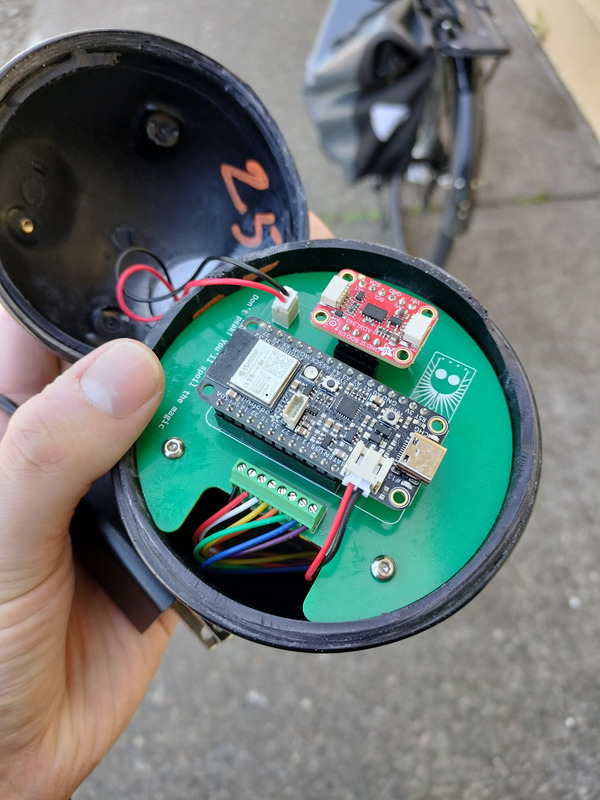
Suddenly I was very, very interested in this 8-ball.
For those who don't mess with electronics much- this is not what the inside of a piece of consumer electronics normally looks like. The black and red boards inside are breakout boards, designed to take chips and components and make them easier to use for prototyping and development. Those boards socket into the larger green carrier board, which links everything together.
The issue is, this is more expensive than just designing a single PCB that carries all the components directly. Not to mention, these weren't obscure enterprise parts- both of the breakout boards came from a company called Adafruit, who sells parts targeted at makers and hobbyists. This looked like someone's DIY project.
... Except. The presentation was a little too polished. The wooden base was custom milled, the casing a little too sleek for this to be someone with a 3d printer and a spare weekend. Maybe it was an educational kit, something meant for a student to put together?
But then why was the ball sealed together? Why was there a message inside saying 'don't peak (sic)'- if this was a kit, you'd have already seen the inside.
I had to know more. Besides- the central board, an Adafruit Feather ESP32 v2- cost $20 on its own, and the whole ball was only $8. I paid for it and went home, excited to investigate more.
In total, the ball consisted of:
- The plastic case and charging base
- An ESP32 Feather, to run the code
- An accelerometer breakout board, to detect the ball being shaken
- A charging port to connect to the magnetic base
- A 1000mAh battery
- And a circular LCD used for the display
A little searching around on Adafruit's site, these components would have cost like $70. That seemed too high for an educational kit, or a novelty product.
Something I've neglected to mention is the ball having the branding 'DGTL' on it. The name sounded weirdly familiar. I tried searching them- but before I could even finish typing the name, my brower's autocomplete filled in the URL, and I immediately remembered where I'd heard of them.
DGTL is a sort of tech-art installation company, they design and build displays and exhibitions for companies- big display walls, choreographed robot arms, that sort of thing. I'd visited their page before to apply for a job they had- that never went anywhere, sadly. But that context suddenly made everything make sense. This was probably made as a little promotional item, to be given away at an industry event or something similar. It needed to look professional and nice, but could be thrown together scrappily on the inside since it wasn't an actual product.
I have no idea why someone decided to give this to Goodwill, but I'm glad they did. And I'm even more glad it got to the sales floor without someone realizing what it was. Then again, I only learned after breaking it, so, I guess it makes sense they wouldn't know.
After letting it charge for a bit, I got it to power on- holding the halves together with painters tape, I could shake the ball and get a random message on the display. Being digital, there could be more messages than would fit on a normal magic 8 ball. I got curious and decided to try dumping the ROM, to see if I could uncover the full list.
Using esptool gave me some files that I was, unfortunately, unqualified to dig through. My hope was to find a chunk of strings in memory somewhere that would correspond to the messages, but I couldn't find anything. The good news was, I didn't need to- Every message got printed to a console during compilation, and that log message was included in the decomp. There were 98 in total- if you're curious, the full list is linked here.
Being an Adafruit board, reprogramming it was super easy. I was able to install the board libraries and get a basic blink program running on the feather in a few minutes.
So, now what?
I don't need the 8 ball, and I definitely wanna repurpose the components to make something else. That circular display especially feels compelling- it's not a very standard component. Though- maybe there's good reason for that. It's a bit hard to think of uses for it where a rectangular screen wouldn't be better. Really, the place I tend to see them most is smartwatches, and the breakout module is too chunky for that.
But, a clock seems like the right way to go. I have a design in mind already that re-purposes as much of the original 8-ball's internals as possible. For now, though, I'm gonna continue poking at what I found and see where it goes.